Ten Questions Before Your Agent Ships
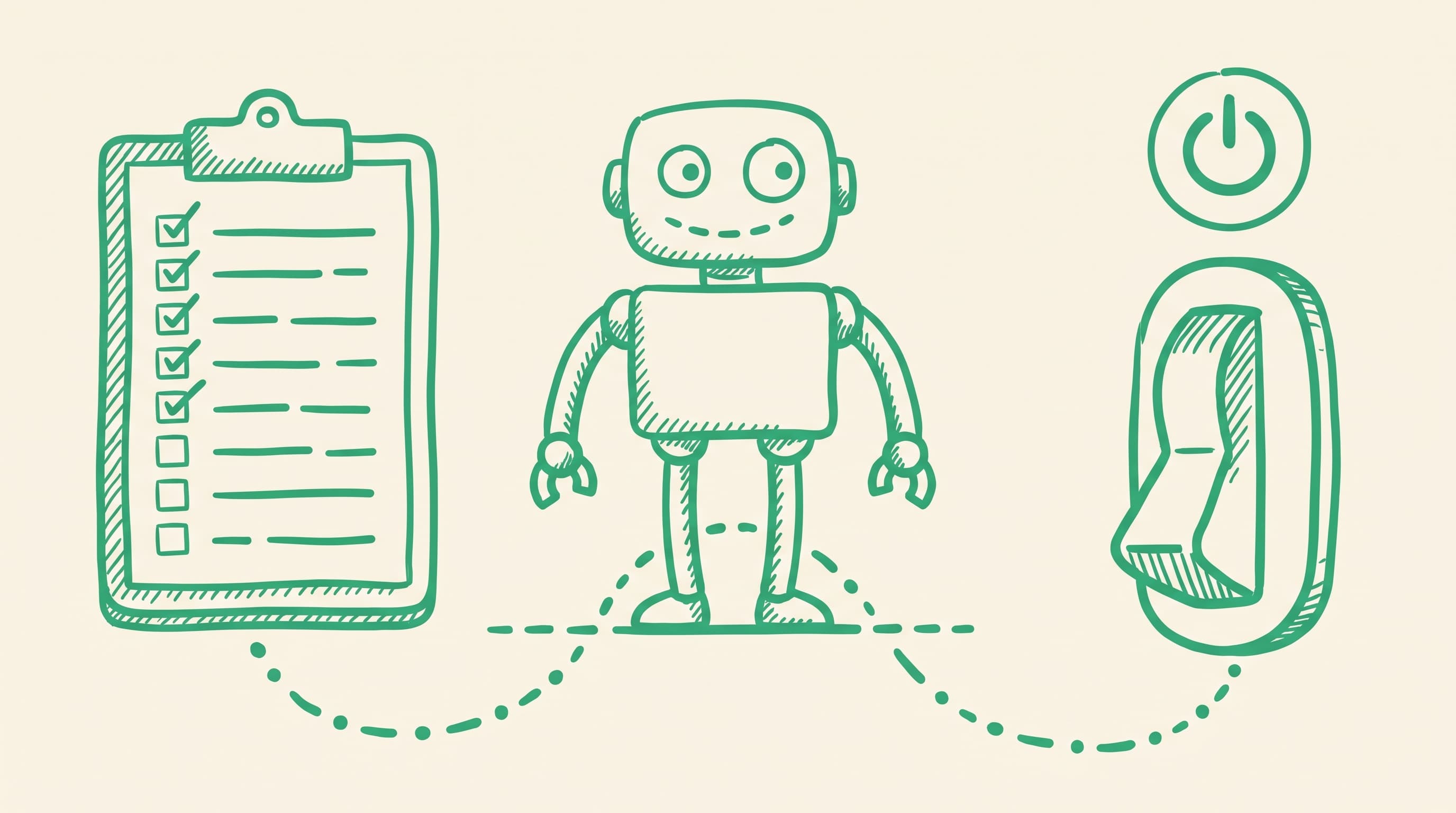
When an AI agent does damage, the first question in the room is usually which vendor failed. Was it the model? The agent platform? The cloud?
That's the wrong question. Vendors supply the tools. The company running the agent makes every decision about what the agent can do, and the question that matters afterward is who made each one.
An agent incident is never a vendor's failure first; it's a decision nobody remembers making.
On October 19 I finally caught up on the recordings of two ISC2 webinars, one on agentic vulnerability scanning with Google Cloud and one on agent identity and governance with AWS and Snyk. The failures the speakers described had something in common. Each one traced back to a decision that had no owner.
So here are those decisions as ten questions, in the order an agent's life runs: create, scope, run, change, review, shut off. Answer them before your agent ships, and write the answers down where the next person can find them.
1. Should this agent exist at all?
Give it one named owner, a person and not a team. The usual failure is quiet: the builder moves teams, the agent keeps running, and nobody left can say what it does or why.
A good answer fits in one sentence: what the agent is for, and who decides when it's no longer needed.
2. What is it allowed to do?
If the scope isn't written down, nobody can say an action was out of bounds. You can only say you're surprised.
Write down the tools it gets, what it can touch, and how much it can spend. Spending caps are softer than they look. On the platform we use, the request that crosses a cap still finishes, so a session can overshoot it. Set caps with a request's worth of headroom.
If the scope isn't written down, every action is in scope.
3. Where are its keys, and do they expire?
No vendor knows which keys your agent holds. AWS's AgentCore Gateway post opens with a made-up but familiar scene: an engineer debugging on a teammate's laptop finds an mcp.json file holding a production database password in plain text.
Give each agent its own keys, keep them on a server and out of config files, and give every key an expiry date. Better still, ask whether it needs the key at all. An agent that only reads public code doesn't need a token to your code host.
The best key to protect is the one you never issued.
4. Can it hand its powers to helper agents?
Platforms make spawning helpers easy. The usual failure is that each helper gets everything the parent has, when it should get less.
If your agent doesn't need helpers, turn them off. If it does, decide what each helper may inherit, and make it a subset.
5. Which actions need a person first?
Approval prompts fail in a predictable way. People click "yes" to every one until the prompts mean nothing.
So make them rare and make them count. Let the expected, safe actions through by an exact rule, send everything else to a person, and deny by default when nobody's there to answer.
An approval prompt that fires on everything protects nothing.
6. Can what it reads give it orders, or run code?
This is the question where every vendor assumes another vendor has it covered. The model maker trains resistance to injected instructions. The platform isolates the sandbox. Neither one owns your answer.
Text isn't the only way in. When we ran our demo agent against a well-known public repo, the riskiest things it found weren't instructions in a file. They were config that runs on its own: a hook that runs a script when a session opens, skills the agent picks up, and a tool server whose operator controls what comes back.
Test it yourself. Build a small repo or document with instructions planted in it, and run your agent against it until it reports them every time. Then check what your agent's workspace loads or runs without asking, and make sure a fooled agent still can't do much: the approval rule from question 5 should hold even when the model doesn't.
Updated Nov 5, 2026: this question now covers config that runs on its own, after a dry run of our demo agent on a public repo.
7. Will the model behave the same tomorrow?
The model maker owns the model. You own which version you run, and whether anyone tests before it changes.
Pin a version where your platform lets you. Where the model name is an alias the vendor can move, assume it will move, and rerun your planted-instruction test on a schedule so you notice.
8. Can we trace an action back to who approved it?
Your cloud keeps the API call logs and your platform keeps the tool call logs. Each holds half the record, and the logs show a role ID, which you can't interview.
Check that your record names the person who said yes to each action, not just the agent that took it. If your platform's own view doesn't record approvers, route approvals through something that does.
A log that can't name the person who said yes is a record of what happened, not of who decided it.
9. When is it reviewed, and when do its keys run out?
Review and expiry are the two controls I see skipped most often. Microsoft's 2024 multicloud risk report found that just 2% of the more than 51,000 permissions granted to human and workload identities were used in 2023.
Put the agent's review date and its key's expiry on the same day. Then renewing the agent and renewing its key is one act, not two that can fall out of step.
10. Can we shut it off fast?
A shutdown only works if you know every place the agent's keys live. Usually nobody does, so the shutdown leaves keys working.
Have a kill switch that stops running sessions, not just new ones, and a backstop: revoking the key at the vendor. One key per agent makes that a single revocation.
You can only shut off what you can find.
What answering them looked like for us
We answered all ten for a small demo agent of our own before it ever ran. Most answers took a sentence.
Three took real work: the exact approval rule, the planted-instruction test, and tying the review date to the key's expiry. Those are also the three I'd start with on any agent.
None of the ten questions is hard on its own. What's hard is that most teams never assign anyone to ask them. Each one answered before launch is one less question someone has to answer after an incident.
Answer the ten questions before an incident asks them for you.
Related Posts
What the Personal Agent Protocol Lets You Say No To
Sierra's Personal Agent Protocol draft gives businesses real controls over the AI agents that act for their customers. Here's what it lets you refuse, and the two places where it says, in its own words, what works on trust.
Your Sign-Off Isn't a Second Opinion
In an Anthropic study, experienced analysts went with their AI agent's secretly assigned lean 86% of the time, and almost none noticed. If a person saying yes is how you keep agents in check, here's how to make that yes count.
Your Agent Never Sees the Trust Dialog
A repo can run code the moment an agent opens it, because the trust dialog that stops it is built for people and headless runs skip it. Here's where your agents open repos and how to close the gap.